English
 français
 Deutsch
 русский
 español
 português
 日本語
 한국의
 العربية
 中文

The Role of Optical Transmission in Modern Networks
Traditional coaxial cables face limitations in distance, bandwidth, and resistance to interference. By switching the transmission path to fiber, operators and service providers gain:
- Extended reach without significant signal loss.
- Support for wide frequency ranges up to 2600 MHz.
- Immunity to external noise and EMI, helping maintain consistent signal quality.
- Flexible integration in both FTTH and satellite TV environments.
These advantages make optical transmitter and receiver solutions an important part of next-generation distribution systems.
Core Features of the Solution
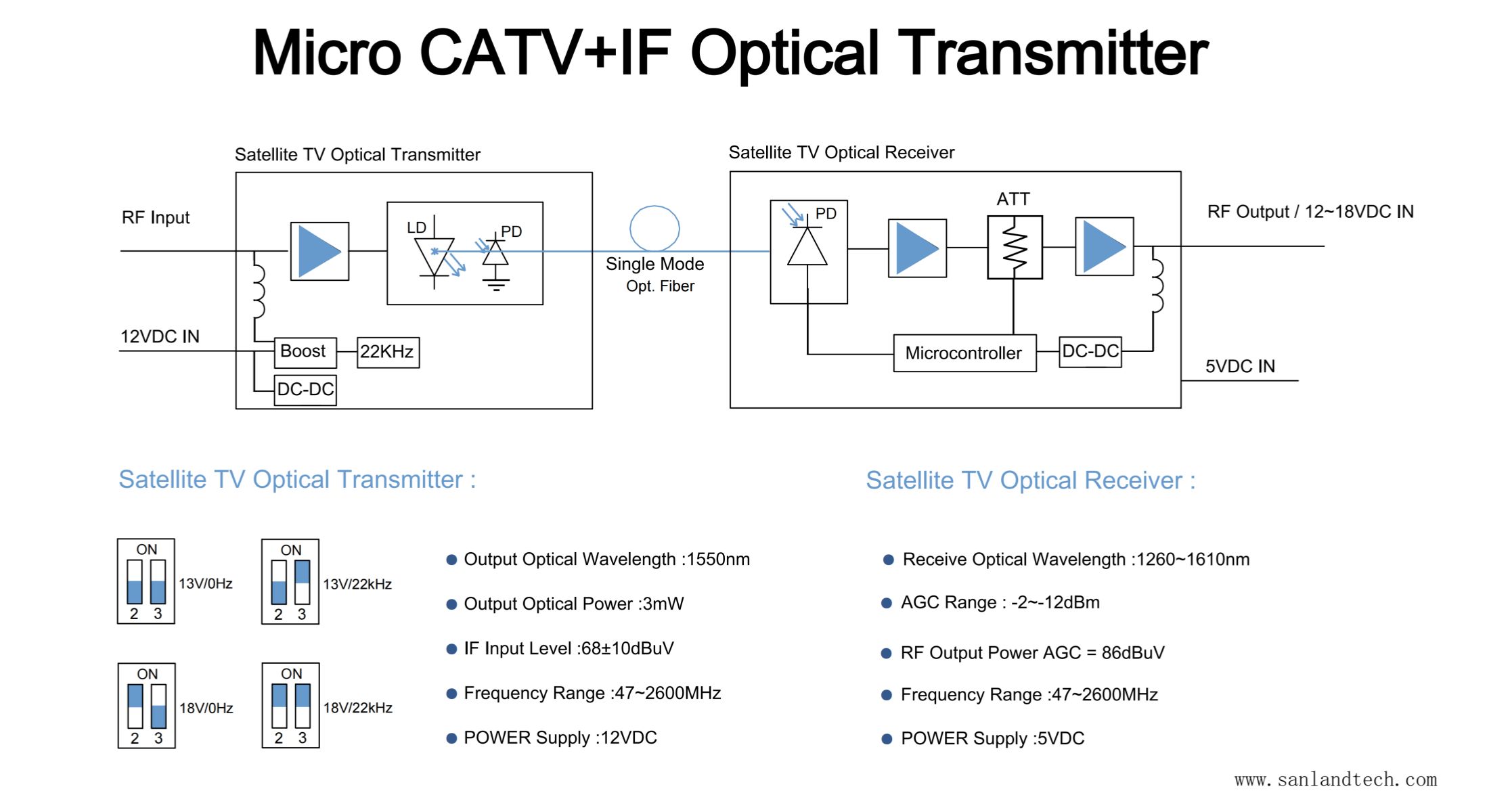
A complete CATV+IF optical link uses a transmitter at the signal source and an AGC receiver at the destination. The two modules perform different functions but operate as one transmission system.
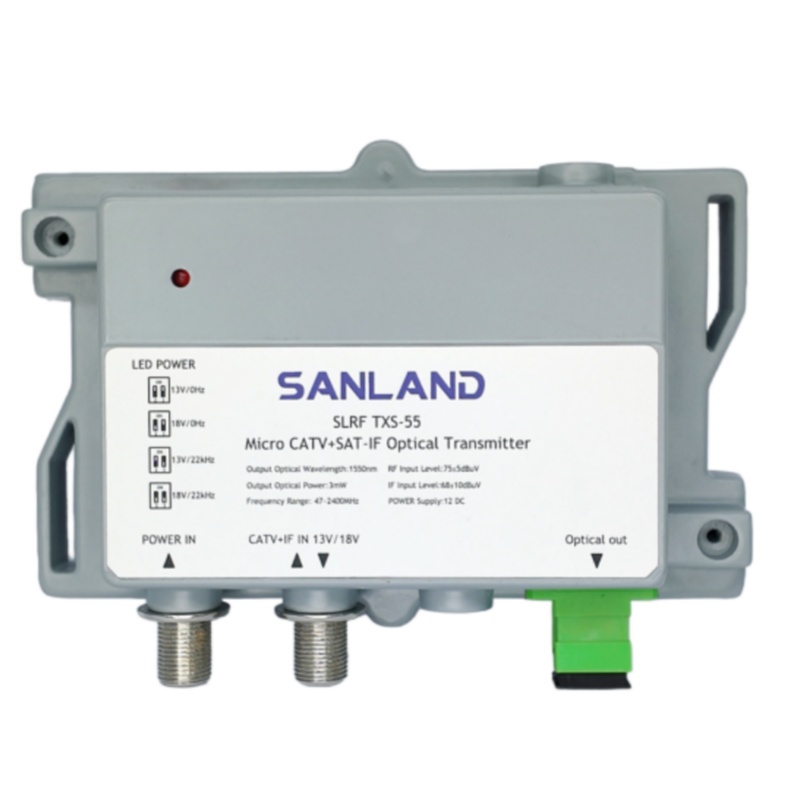
Optical Transmitter
1550 nm wavelength · 3 mW optical output
The transmitter converts CATV and satellite IF signals into optical transmission for delivery over single-mode fiber.
- Delivers stable optical power for long-distance fiber transmission.
- Supports 47–2600 MHz for CATV and satellite IF signals.
- Uses a compact and energy-efficient design powered by 12 VDC.
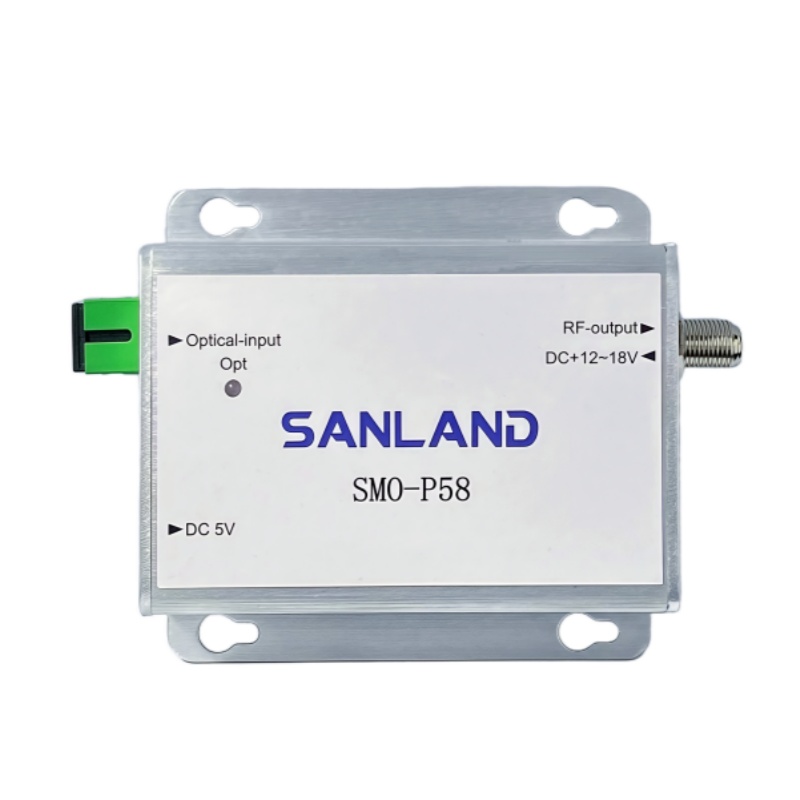
Optical Receiver with AGC
70–2600 MHz bandwidth · Stable RF output
At the destination, the receiver converts the optical signal back to RF. Its AGC function maintains a controlled output as received optical power changes.
- Covers 70–2600 MHz with ±2 dB frequency response flatness.
- Maintains 84–88 dBµV RF output as optical input varies from −12 to −2 dBm.
- Maintains high CNR and MER for clear video and stable broadband performance.
- Combines low power consumption, compact dimensions, and an easy-to-read monitoring LED.
Application Scenarios
FTTH (Fiber to the Home)
The optical link brings CATV and broadband services directly to subscribers, helping end users receive strong, consistent signals with minimal maintenance.
Satellite TV Distribution
Satellite IF and CATV signals can be transported through a single fiber. The system is compatible with 13/18 V control and 22 kHz tone switching commonly used in satellite networks.
Mixed Service Networks
CATV, high-speed internet, and satellite broadcasting can be integrated into one solution, simplifying the network architecture while reducing operating costs.
Why Operators Choose CATV+IF Optical Solutions
For network operators and system integrators, the value of the optical link comes from its combination of transmission performance and practical deployment features:
- Wideband performance: Supports existing and future services up to 2600 MHz.
- Reliable output: AGC technology limits fluctuations caused by optical power variation.
- Easy integration: Compact construction and SC/APC connectors simplify deployment.
- Ready for expansion: Fiber routing provides flexibility as service areas and distribution networks grow.
Final Thoughts
For network operators, ISPs, and system integrators, a CATV+IF optical transmitter and receiver system is a proven solution for FTTH and satellite TV applications. By combining the strengths of fiber optics with AGC, it supports high-quality service delivery, stable network performance, and a practical path for future broadband and broadcasting expansion.
To learn more about applying CATV+IF optical transmission in your network, and assistance confirming the required.



 IPv6 network supported