English
 français
 Deutsch
 русский
 español
 português
 日本語
日本語 한국의
한국의 العربية
 中文
中文
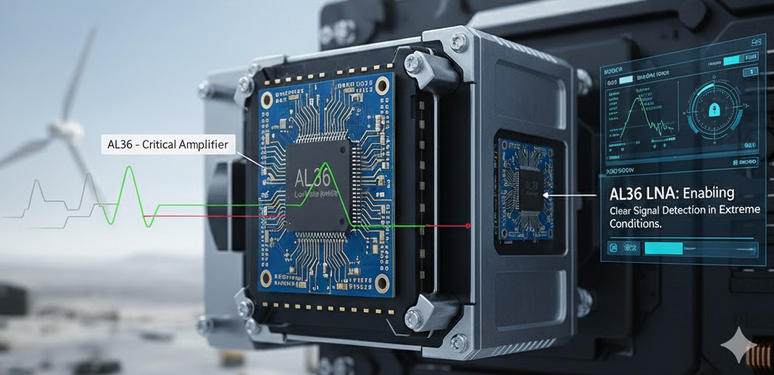
You want the best performance for your RF and telecom projects. The AL36 Low Noise Amplifier delivers with an ultra-low noise figure, high OIP3, and flexible power options. You can rely on its stable operation in demanding environments. Its compact package design ensures easy integration into your system. This amplifier stands out for professionals who require precision, reliability, and advanced features.
Key Takeaways
-
The AL36 Low Noise Amplifier offers ultra-low noise figures, enhancing signal clarity in RF applications.
-
Its high OIP3 performance ensures strong signal integrity, making it ideal for multi-carrier systems.
-
Flexible power options allow you to adjust supply current and bias voltage, optimizing performance for various designs.
-
The compact 2 x 2 mm DFN package simplifies integration into space-constrained layouts.
-
Reliable operation in demanding environments makes the AL36 a trusted choice for mission-critical applications.
AL36 Low Noise Amplifier Performance
Technical Specifications
You demand precision and reliability in your RF designs. The AL36 Low Noise Amplifier delivers both through advanced GaAs pHEMT MMIC technology. This amplifier comes in a compact 2 x 2 mm DFN package with 8 pins, making it easy for you to integrate into space-constrained layouts. You benefit from its robust construction, which meets MSL1 standards at 260°C per JEDEC J-STD-020. This ensures compatibility with modern soldering processes.
Here is a quick overview of the key specifications:
|
Feature |
Specification |
|---|---|
|
Technology |
GaAs pHEMT MMIC |
|
Package |
2 x 2 mm DFN, 8-pin |
|
Supply Current |
30 – 100 mA (adjustable) |
|
Bias Voltage |
3 – 5 V (flexible) |
|
MSL Rating |
MSL1 @ 260°C |
|
Frequency Range |
700 – 3800 MHz |
You can rely on these specifications for high-performance telecom and RF applications. The design supports stable operation in demanding environments, which is essential for mission-critical systems.

Noise Figure Across Frequencies
You need a Low Noise Amplifier that preserves signal clarity across a wide frequency range. The AL36 excels with ultra-low noise figures at key bands:
-
0.30 dB at 850 MHz
-
0.40 dB at 1850 MHz
-
0.50 dB at 2500 MHz
-
0.75 dB at 3600 MHz
Tip: Lower noise figures mean less signal degradation and higher sensitivity in your receivers.
You can deploy the AL36 in base stations, repeaters, and other sensitive RF front ends. The consistent low noise performance ensures your system captures weak signals with minimal interference. This gives you a competitive edge in applications where every decibel counts.
OIP3 and Signal Integrity
You want your Low Noise Amplifier to handle strong signals without distortion. The AL36 achieves an impressive output third-order intercept point (OIP3) of over +34 dBm from 700 to 3800 MHz. High OIP3 performance means your system maintains linearity, even in environments with multiple strong signals.
-
You reduce the risk of intermodulation distortion.
-
You maintain signal integrity for both analog and digital communications.
-
You ensure compliance with strict telecom standards.
This makes the AL36 ideal for multi-carrier systems, dense urban deployments, and advanced wireless infrastructure.
Power and Bias Flexibility
You need flexibility to optimize your design for power consumption and performance. The AL36 Low Noise Amplifier gives you control with an adjustable supply current from 30 to 100 mA. You can fine-tune the bias voltage between 3 and 5 V, adapting to different power supply architectures.
-
Lower current settings help you minimize power draw in battery-powered systems.
-
Higher current settings let you maximize gain and linearity for demanding applications.
The temperature and process-stable active bias technology ensures consistent performance, even as environmental conditions change. You can trust the AL36 to deliver reliable results in both lab and field deployments.
Note: This flexibility simplifies your design process and reduces the need for multiple amplifier variants.
By choosing the AL36, you equip your projects with a Low Noise Amplifier that combines technical excellence, adaptability, and ease of integration.
Low Noise Amplifier Competitors
You face a crowded market when selecting a Low Noise Amplifier for your RF or telecom project. Leading competitors include models from Analog Devices, Qorvo, and Skyworks. These brands offer amplifiers with similar frequency coverage and noise performance. For example, Analog Devices provides solutions with low noise figures and high linearity. Qorvo and Skyworks also deliver strong OIP3 performance and compact packaging. However, not every competitor matches the AL36’s combination of ultra-low noise, flexible biasing, and robust temperature stability.
Feature and Price Analysis
You want to maximize value without sacrificing performance. The AL36 stands out with its ultra-low noise figure, reaching 0.30 dB at 850 MHz. Many competing amplifiers operate above 0.4 dB at similar frequencies. You benefit from the AL36’s high OIP3, which exceeds +34 dBm across a wide frequency range. This level of linearity is essential for modern wireless systems.
When you compare pricing, you notice that low noise amplifiers often come at a premium. The AL36 positions itself competitively, offering advanced features at a price point similar to or slightly above mainstream alternatives. You pay for superior noise performance and flexibility, which can reduce the need for additional filtering or gain stages in your design.
Tip: Investing in a high-performance amplifier like the AL36 can lower your total system cost by simplifying your RF chain.
Reliability and Integration
You need an amplifier that integrates easily into your design and performs reliably in the field. The AL36 uses a miniature 2 x 2 mm DFN package, which saves board space and supports high-density layouts. You benefit from its MSL1 rating at 260°C, which ensures compatibility with standard soldering processes. The temperature and process-stable active bias technology keeps your system stable, even as environmental conditions change.
Competitors may offer similar packaging, but not all provide the same level of process stability or bias flexibility. You can adapt the AL36 to a wide range of power supply architectures, making it a versatile choice for both new designs and upgrades.
AL36 Advantages and Drawbacks
You gain several advantages when you choose the AL36 for your next project:
-
Ultra-low noise figure across a broad frequency range
-
High OIP3 for excellent signal integrity
-
Flexible supply current and bias voltage
-
Compact, easy-to-integrate package
-
Reliable operation in demanding environments
You should also consider some practical aspects:
-
Low noise amplifiers, including the AL36, tend to be more expensive than standard amplifiers.
-
These amplifiers are sensitive to flicker noise and DC offsets, which may require careful system design.
Note: The AL36’s strengths in noise performance, linearity, and flexibility make it a top contender for high-performance RF and telecom applications.
Customer Reviews
You want to know how real users feel about the AL36 Low Noise Amplifier. Many customers highlight the amplifier’s consistent performance and easy integration. You see positive feedback from engineers who use the AL36 in both new designs and upgrades.
-
Ease of Use: Users appreciate the compact DFN package. You can fit it into tight spaces without redesigning your board.
-
Performance: Customers report that the ultra-low noise figure improves receiver sensitivity. You notice better signal clarity in your systems.
-
Reliability: Field engineers mention stable operation in harsh environments. You can trust the AL36 for mission-critical applications.
“I installed the AL36 in our base station prototypes. The noise floor dropped immediately, and integration was seamless.” — RF Design Engineer
Expert Opinions
Industry experts recognize the AL36 as a top performer in its class. You find that professionals value its technical strengths.
|
Expert |
Key Takeaway |
|---|---|
|
RF Systems Consultant |
“The AL36 sets a new standard for low noise and linearity in compact MMIC amplifiers.” |
|
Telecom Hardware Reviewer |
“You get flexibility with supply current and bias voltage, which simplifies your design process.” |
Experts often recommend the AL36 for advanced wireless infrastructure and sensitive RF front ends. You benefit from their confidence in the product’s reliability and performance.
Application Scenarios
You can deploy the AL36 in a wide range of applications. Here are some common scenarios:
-
Cellular Base Stations: Improve receiver sensitivity and reduce dropped calls.
-
RF Repeaters: Enhance signal clarity in urban and rural deployments.
-
Test Equipment: Achieve accurate measurements with minimal noise interference.
-
IoT Gateways: Maintain reliable connectivity in compact, power-sensitive devices.
Tip: You can use the AL36 in both new designs and as a drop-in replacement for existing amplifiers.
You gain flexibility and confidence when you choose the AL36 for your next project.
Value Assessment
Cost vs. Performance
You want to maximize your investment in RF components. The AL36 Low Noise Amplifier delivers exceptional value by combining industry-leading noise performance with high linearity. You get a noise figure as low as 0.30 dB at 850 MHz, which outperforms many amplifiers in the same price range. This means you can achieve better receiver sensitivity without overspending.
-
Key Value Points:
-
Ultra-low noise figure for improved signal clarity
-
High OIP3 for robust signal handling
-
Flexible biasing options to match your system needs
-
Tip: By choosing the AL36, you often reduce the need for extra filtering or gain stages, which can lower your total system cost.
Long-Term Reliability
You need an amplifier that performs consistently over time. The AL36 uses temperature and process-stable active bias technology. This ensures stable operation even when environmental conditions change. You can trust the AL36 in both lab and field deployments.
|
Reliability Feature |
Benefit to You |
|---|---|
|
Active bias stability |
Consistent performance |
|
MSL1 @ 260°C rating |
Reliable soldering process |
|
GaAs pHEMT MMIC design |
Proven durability |
You can deploy the AL36 in mission-critical systems with confidence. You know it will maintain performance year after year.
Support and Warranty
You expect strong support when you choose a high-performance component. The AL36 comes with comprehensive technical documentation and responsive customer service. You can access application notes, reference designs, and expert guidance.
-
Support Highlights:
-
Detailed datasheets and design resources
-
Fast response from technical support teams
-
Warranty coverage for peace of mind
-
Note: You can rely on the AL36 manufacturer to assist you throughout your design and deployment process. This support helps you resolve issues quickly and keep your projects on track.
You want the best for your RF and telecom projects. The AL36 Low Noise Amplifier stands out with its ultra-low noise, high OIP3, and flexible design. You benefit from strong user feedback and proven reliability. If you need top-tier performance and easy integration, you should choose the AL36.
Recommendation: Select the AL36 for demanding applications where signal clarity and stability matter most.
FAQ
What frequency range does the AL36 support?
You can use the AL36 across 700 to 3800 MHz. This wide range covers most telecom and RF applications. You get flexibility for both legacy and next-generation systems.
How do you set the supply current and bias voltage?
You adjust the supply current from 30 to 100 mA. You set the bias voltage between 3 and 5 V. This flexibility lets you optimize for power or performance.
Is the AL36 suitable for high-density layouts?
You benefit from the compact 2 x 2 mm DFN package. You can integrate the AL36 into space-constrained designs without difficulty.
What support resources are available?
You access detailed datasheets, application notes, and reference designs. You also receive responsive technical support for design and troubleshooting.
Can you use the AL36 in harsh environments?
You rely on the AL36’s temperature and process-stable active bias technology. This ensures consistent performance in both lab and field conditions.



 IPv6 network supported